5 Digital Scale Mistakes UK Smoke Shop Customers Make | Namasteji
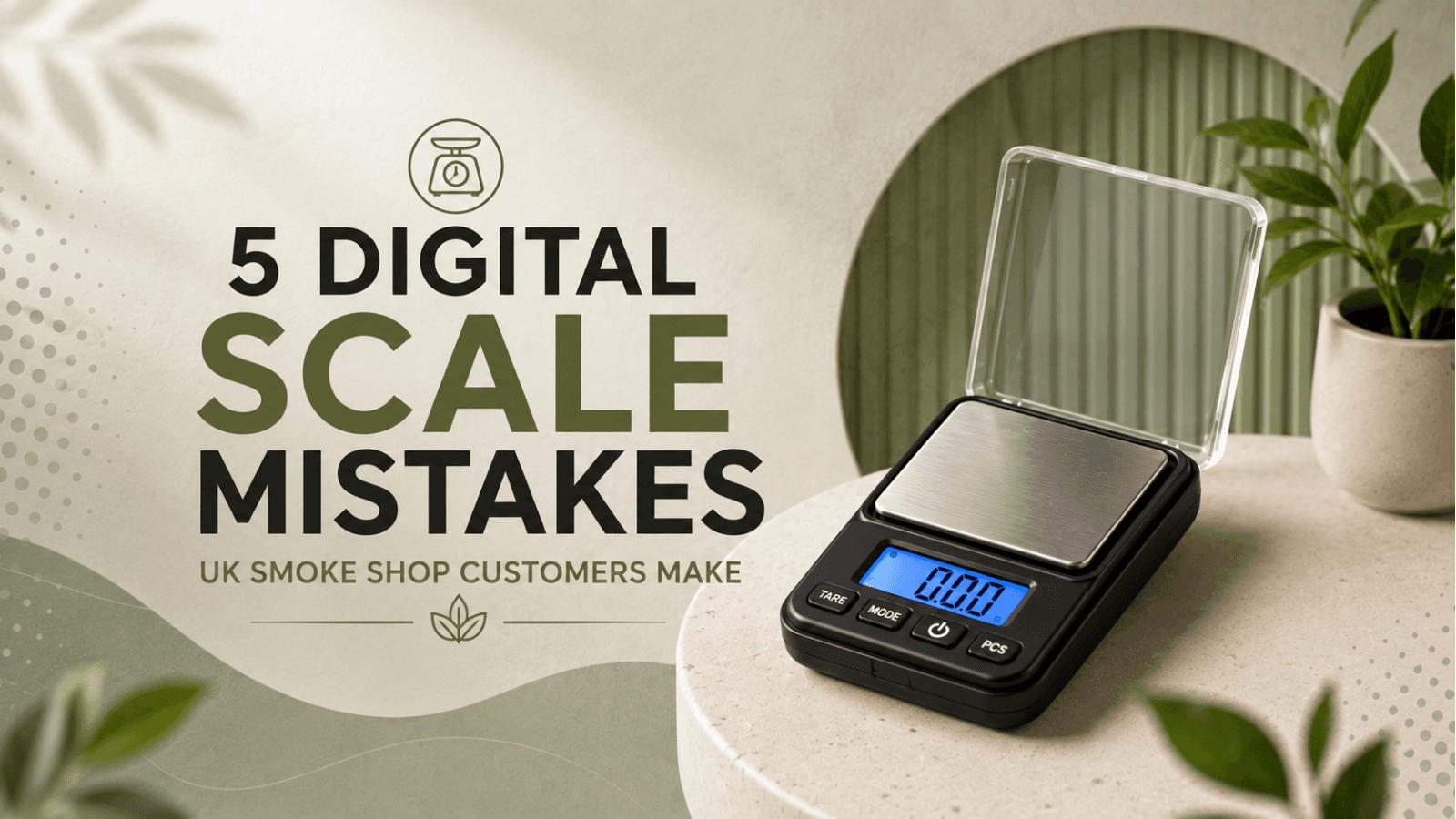
5 Digital Scale Mistakes UK Smoke Shop Customers Make
Most customers who return a digital scale as “inaccurate” are using a perfectly functional scale incorrectly. Digital scales are precision instruments, and a handful of consistent user errors are responsible for the vast majority of inaccuracy complaints. Here are the five most common.
Mistake 1: Not Zeroing Before Each Use
A scale that isn't zeroed before use will include the weight of the pan or any residue from the previous weighing in its reading. This is one of the most common causes of consistent over-reading.
The fix: press the tare/zero button before every single weighing, even if the display already shows 0.00. This resets any residual weight and ensures the reading reflects only what you add to the pan.
Mistake 2: Weighing on an Uneven or Vibrating Surface
A Digital Pocket Scale uses a load cell to measure weight, and any movement or surface instability during a reading affects the result. Weighing on a washing machine, a table being bumped, or an uneven surface introduces error into every reading.
The fix: always weigh on a flat, stable surface away from vibration. If the reading fluctuates, wait for it to settle fully before recording it.
Mistake 3: Not Calibrating After Battery Change or Transport
Digital scales need to be calibrated to read accurately. Most pocket scales come factory calibrated, but calibration can drift after battery changes, impacts, or extended transport. A scale that consistently reads high or low by the same amount almost certainly needs recalibrating.
The fix: check the manual for the calibration procedure - most scales require a known calibration weight to be placed on the pan and the calibration mode confirmed. Using the correct calibration weight is important; improvising with a coin is unreliable.
Mistake 4: Overloading the Scale
Every scale has a maximum capacity. Placing more weight on the pan than the scale is designed for doesn't just give an inaccurate reading - it can permanently damage the load cell, meaning the scale will read inaccurately on every use afterwards.
The fix: check the scale's capacity before weighing and never exceed it. For small pocket scales rated to 100g or 200g, this limit is easier to exceed than it sounds.
Mistake 5: Using a Scale in the Wrong Temperature or Humidity
Digital scales are sensitive to temperature changes. A scale taken from a cold environment and used immediately, or placed near a heat source, can give inaccurate readings until its internal temperature stabilises.
The fix: allow a scale at least five minutes to acclimatise to room temperature before use if it's been stored in a significantly different temperature environment.
Retail Insight: the majority of digital scale returns come down to one of these five issues. Staff who can ask a customer two or three diagnostic questions at the counter - 'Did you zero it first?' / 'Was it on a flat surface?' / 'Has it been calibrated recently?' - resolve most complaints without a formal return.
Browse our wholesale digital scales range.
Frequently Asked Questions - Digital Scale Accuracy - User Guide
Q1: Why is my digital scale not accurate?
The five most common causes are not zeroing before use, uneven surface, uncalibrated scale, overloading, and temperature change.
Checking each of these in order usually identifies the issue without needing to replace the scale.
Q2: How do I zero my digital scale?
Press the tare or zero button before every weighing to reset the display to 0.00.
Even if the display already shows zero, pressing the tare button ensures any residual load from the pan or debris is excluded from the reading.
Q3: How do I calibrate a digital scale?
Enter calibration mode (check the manual for your model) and place a known calibration weight on the pan when prompted.
Calibration weights are sold separately and are more reliable than improvised weights like coins, which vary in actual weight more than most people expect.
Q4: Can a digital scale be repaired if overloaded?
Overloading can permanently damage the load cell, which is not field-repairable in most pocket scales.
Prevention is the only reliable approach - never exceed the stated maximum capacity, even briefly.
Q5: Why does my scale give different readings for the same item?
Variable readings usually point to surface instability, an overloaded or damaged load cell, or a battery running low.
Testing on a firm, flat surface with fresh batteries eliminates the most common causes of inconsistent readings.
Q6: What surface should I use a digital scale on?
A firm, flat, vibration-free surface - a hard kitchen counter or table works well.
Soft surfaces like carpets or padded mats absorb some of the weight reading, causing the scale to under-read consistently.
Q7: How often does a digital scale need calibrating?
After battery changes, after impacts or drops, and whenever readings seem consistently off.
A scale used gently and stored well may not need recalibration for months, while one that's regularly transported or handled may benefit from more frequent checks.
Q8: Does temperature affect a digital scale?
Yes - significant temperature changes affect accuracy until the scale acclimatises.
Five minutes at room temperature before use is usually enough to stabilise a scale that's been in a cold or hot environment.
Q9: What is the tare function on a digital scale?
The tare function zeros the scale with an item already on it, so subsequent additions are weighed without including that item's weight.
This is useful when weighing into a container - place the empty container on the scale, press tare, then add your material to measure only the added weight.
Q10: What is the maximum weight for a pocket scale?
It varies by model - typical pocket scales in the UK market are rated from 100g to 500g capacity.
Exceeding the stated maximum, even briefly, risks permanently damaging the load cell and causing the scale to read inaccurately on all subsequent uses.
Frequently Asked Questions - For Retailers & Trade Buyers
Q1: What's the most common reason digital scales are returned?
Inaccurate readings from user error - primarily not zeroing, soft surfaces, or uncalibrated scales - account for most returns.
A brief diagnostic question at the counter ('Did you zero it before use?') resolves most complaints without a formal return.
Q2: Should I sell calibration weights alongside scales?
Yes - it's a natural low-cost add-on and gives customers the right tool to maintain accuracy.
Customers who want to recalibrate their scale need a calibration weight - without one, they typically return the scale as faulty instead.
Q3: Are more expensive scales genuinely more accurate?
At the price points in this category, yes - mid-range scales are noticeably more consistent than the cheapest options.
Very low-cost scales often use lower-quality load cells that drift more quickly and are more sensitive to the common user errors described in this guide.
Q4: How should digital scales be displayed in store?
At the counter or near the till where customers can see the range clearly - they're a compact, low-footprint display product.
Scales are often an impulse or add-on purchase when a customer is already buying grinders or papers - till proximity increases conversion.
Q5: Are digital scales a one-off purchase or a repeat purchase?
Mainly one-off, but calibration weights and replacement batteries are small-value repeat add-ons.
The scale itself is replaced when it fails or is lost rather than bought repeatedly - which is why reducing return rates matters more for this category than driving reorder frequency.
Q6: Do I need to stock multiple capacity ranges?
A 100g and a 200–300g model covers most customer needs in a smoke shop context.
Very few customers need higher-capacity models for the use cases typical in this category, so two capacity options is usually sufficient.
Q7: Should I include a care card with scale purchases?
Yes - a simple note covering zeroing, surface requirements, and calibration after battery changes reduces returns.
Since the five errors in this guide are responsible for most accuracy complaints, addressing them at point of sale is lower cost than processing returns.
Q8: Is digital scale demand seasonal?
No - demand for pocket scales is fairly consistent throughout the year in this category.
Unlike some accessories that follow seasonal patterns, scales sell based on customer need rather than timing.
Q9: What's the margin like on digital scales?
Mid-range pocket scales carry solid margin relative to their wholesale cost.
Calibration weights stocked alongside scales add a high-margin accessory to a relatively compact category footprint.
Q10: Where can I order digital scales wholesale in the UK?
Namasteji supplies digital pocket scales and accessories to UK retailers with fast trade delivery.
Ordering scales alongside your wider accessories range from one supplier keeps stock management straightforward.


Related Posts